How to run a round robin pod (formats, rotation, scoring)
Step-by-step rules for running a 12-player, 3-court round robin pickleball pod, including rotation, scoring, and tiebreakers.
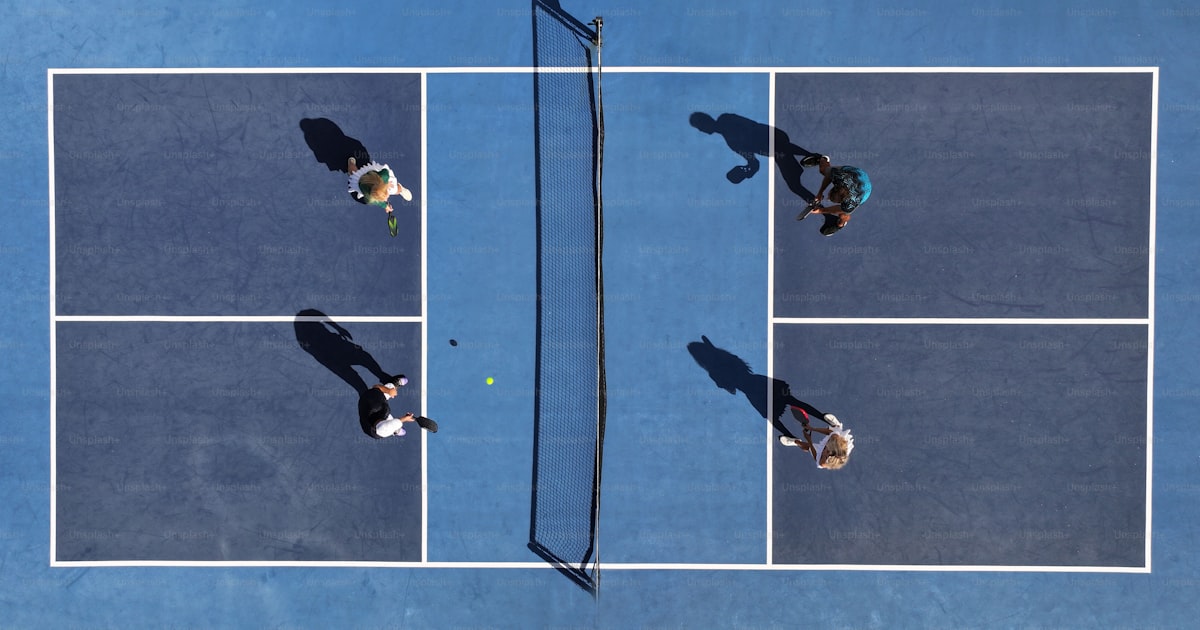
Round robin is the format every pickleball pod eventually adopts, and for good reason — it gives every player roughly equal court time, mixes the partner combos, and ends with one clear winner. Here's the operational playbook for running it well.
Round robin vs ladder vs king-of-the-court
A quick comparison so you pick the right format:
- Round robin — Everyone plays everyone (or close). Fixed number of rounds. Fair court time. Best for social pods of 8–16 players.
- Ladder — Players are ranked, the top of one court plays the bottom of the next, winners move up. Competitive feel. Best for skill-stratified groups.
- King-of-the-court — Winners stay, losers rotate off. Fun energy. Strongest team plays the most, weakest plays the least. Not ideal for skill-mixed crews.
For a friend-group pod with 12ish players and 3 courts, round robin wins almost every time.
The 12-player, 3-court setup
This is the most common configuration in real pods. Here's how to actually run it:
Round 0 (warmup): 10 minutes. Players pair up loosely and warm up on any court.
Round 1: Use a random pairing (Pickleloonies can generate this for you in two taps, or write names on slips and draw). Court 1 plays court 1, etc. Three games in parallel.
End of round 1: Winners shift to a higher-numbered court (court 1 winners go to court 2, court 2 winners go to court 3, court 3 winners stay on court 3). Losers slide the other direction. Partners switch — pair the winner from one court with the loser from the next court for balance.
Rounds 2–6: Repeat the rotation. After 6 rounds, total wins decide the ranking.
Rotation rules in detail
The two rules that matter:
- Don't keep partners across rounds. New partner every round forces players to adapt and keeps the social mix high. Without this, you end up with one strong pair dominating and one weak pair stuck on the same court.
- Don't rematch opponents until you've played everyone else. Track it with a simple matrix or let an app do it.
If you're doing this by hand, the easiest visual aid is to write all 12 names on a whiteboard and draw lines connecting partners and opponents as you assign each round. After round 3 it should be obvious who hasn't played who.
Scoring and tiebreakers
Rally-scoring to 11, win by 2, hard cap at 15. Each player tracks their personal wins across the night. After the final round:
- Total wins — highest count wins.
- Head-to-head — if two players are tied, the one who beat the other in a head-to-head round wins.
- Point differential — if still tied, sum (points won – points lost) across all rounds.
For ties beyond that, a sudden-death tiebreaker round to 7 points works.
When to switch formats
Three signs you've outgrown round robin:
- You have more than 20 players. Round robin gets math-heavy at scale. Switch to bracket play.
- Your skill range is wider than 1.0 DUPR points. Random pairing produces lopsided matchups. Switch to skill-tiered brackets.
- People stop coming because it's too repetitive. Mix in king-of-the-court or themed nights every fourth session.
For the broader pod-organization playbook, the crew organization guide covers how to schedule the round robin night itself. The glossary defines all the in-app terms. And the USA Pickleball tournament formats guide is the authoritative reference for competition-grade formats.
Frequently asked questions
+What's the difference between a round robin and king-of-the-court?
Round robin gives every player roughly equal court time and equal matchups. King-of-the-court keeps winners on court and rotates losers off — fun, but the strongest team plays the most and the weakest plays the least.
+How long does a 12-player, 3-court round robin take?
About 90 minutes for 6 rounds of 11-point games. That gives every player roughly 5 games on court with mixed partners.
+What if we have 9, 10, or 11 players?
9 means one sit-out per round, rotated. 10 means two sit-outs per round, rotated. Don't try to run round robin with fewer than 8 — switch to king-of-the-court or open play.
+How do you handle skill imbalance?
Either let the algorithm randomize (which tends to balance over enough rounds) or use seeded brackets where the top 4 play each other and the bottom 4 play each other. Most casual pods do random.
+What scoring system is best?
Rally-scoring to 11, win by 2, hard cap at 15. Faster than traditional 11-by-2 unbounded. Easier to fit into a fixed time window.